Perceptive humanoid fall recovery
Test-Time Motion Steering for Perceptive Humanoid Fall Recovery
Generate different ways to recover, adapt to the surroundings, and steer the motion at test time.
Why the recovery motion matters
Getting up is only part of the problem.
An obstacle changes which recovery motions are useful. These examples show collision without visual awareness, adaptation with depth observations, and a guided recovery toward the unobstructed side.
How it works
From recovery references to steerable motion.
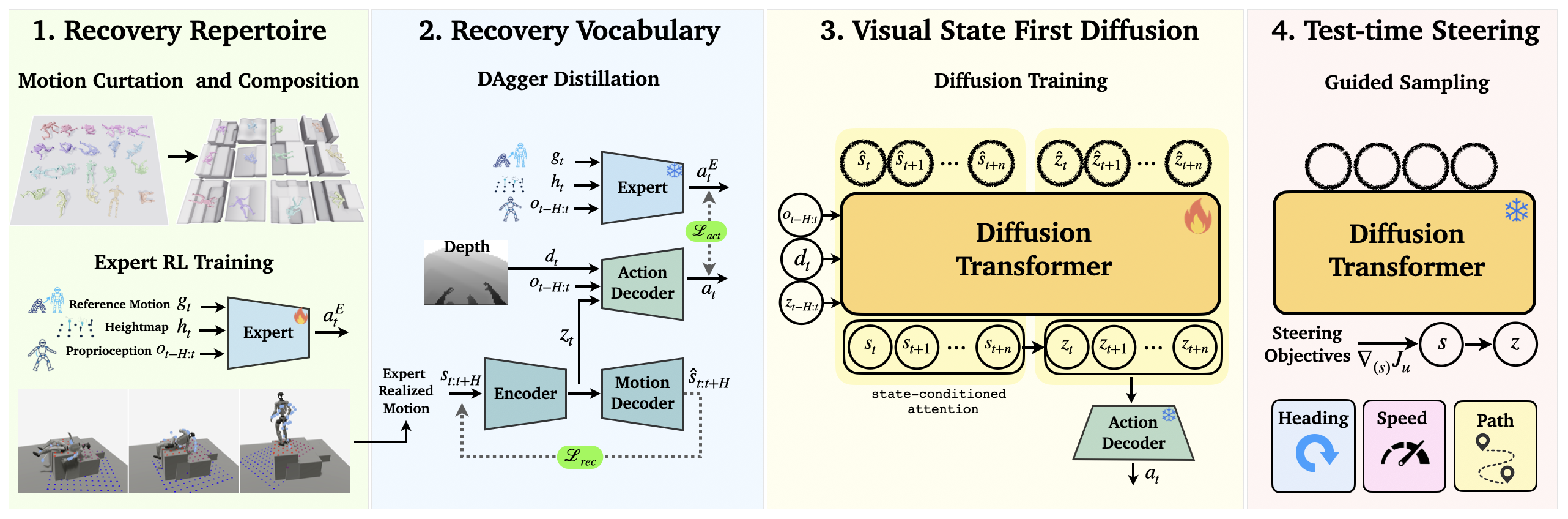
Build a recovery repertoire
Compose motion references and align them with terrain. A teacher turns these references into physical recoveries.
Learn a motion vocabulary
Distill the teacher into a latent-conditioned tracker that executes recovery motion with sensory feedback.
Generate and steer motion
Generate future states and corresponding motion latents, with objectives guiding the recovery at test time.
Data curation & teacher training
From motion references to physical recoveries.
Motion matching creates alternative recovery sequences, which are aligned to terrain. A teacher learns to execute these references in simulation, resolving balance and contact. Its realized motions provide the data for learning the tracker and diffusion model.
Multimodal recovery
A starting pose can lead to different recoveries.
Three unguided recoveries from supine (face-up) starts illustrate different ways to get up.
Terrain awareness
Recover with the surroundings in view.
Stairs and platforms change the support available during recovery. Onboard depth observations condition the motion as the robot gets up.
Test-time steering
Guide how the robot recovers.
Steering objectives influence the generated recovery motion. Hardware demonstrations show guided motions on flat ground and around raised terrain.
Flat ground
Raised terrain
Simulation
Different objectives, different recoveries.
Guide the recovery path, heading, or rise timing. These comparisons illustrate the resulting changes in motion.